Digital Impressions vs Traditional Impressions Explained in 5min
This article breaks down how scanning changes daily clinic operations compared to trays: what happens before the patient sits down, what changes during the appointment, where errors show up, and how lab handoff and remake loops differ.

Handles the surgical foundation behind every complex implant case — bone grafting, sinus lifts, extractions, and jaw reconstruction.
Book a ConsultationDigital impressions vs traditional impressions: what changes in daily workflow
If you switch to intraoral scanning and expect “everything gets faster,” you’ll be disappointed.
The real shift is different: the mess moves. Traditional impressions concentrate pain into a few obvious moments (tray selection, set time, pull, retake). Digital impressions distribute pain across many smaller decisions (isolation, capture strategy, patching, bite registration, QC, export). When the team does not standardize those decisions, scanning can feel like it adds steps instead of removing them.
When it doeswork, it’s not because scanning is inherently superior. It works because the workflow becomes more measurable, more correctable in real time, and less dependent on shipping and lab interpretation.
Let’s break down what actually changes in daily operations, stage by stage, the way your team will experience it.
The biggest difference in one sentence
Traditional impressions hide errors until the lab calls you. Digital impressions surface errors while the patient is still in the chair.
That single fact affects everything else: scheduling, assistant training, remakes, lab relationships, even how dentists “feel” during a busy day.
1) Before the patient sits down
Traditional: preparation is mostly physical
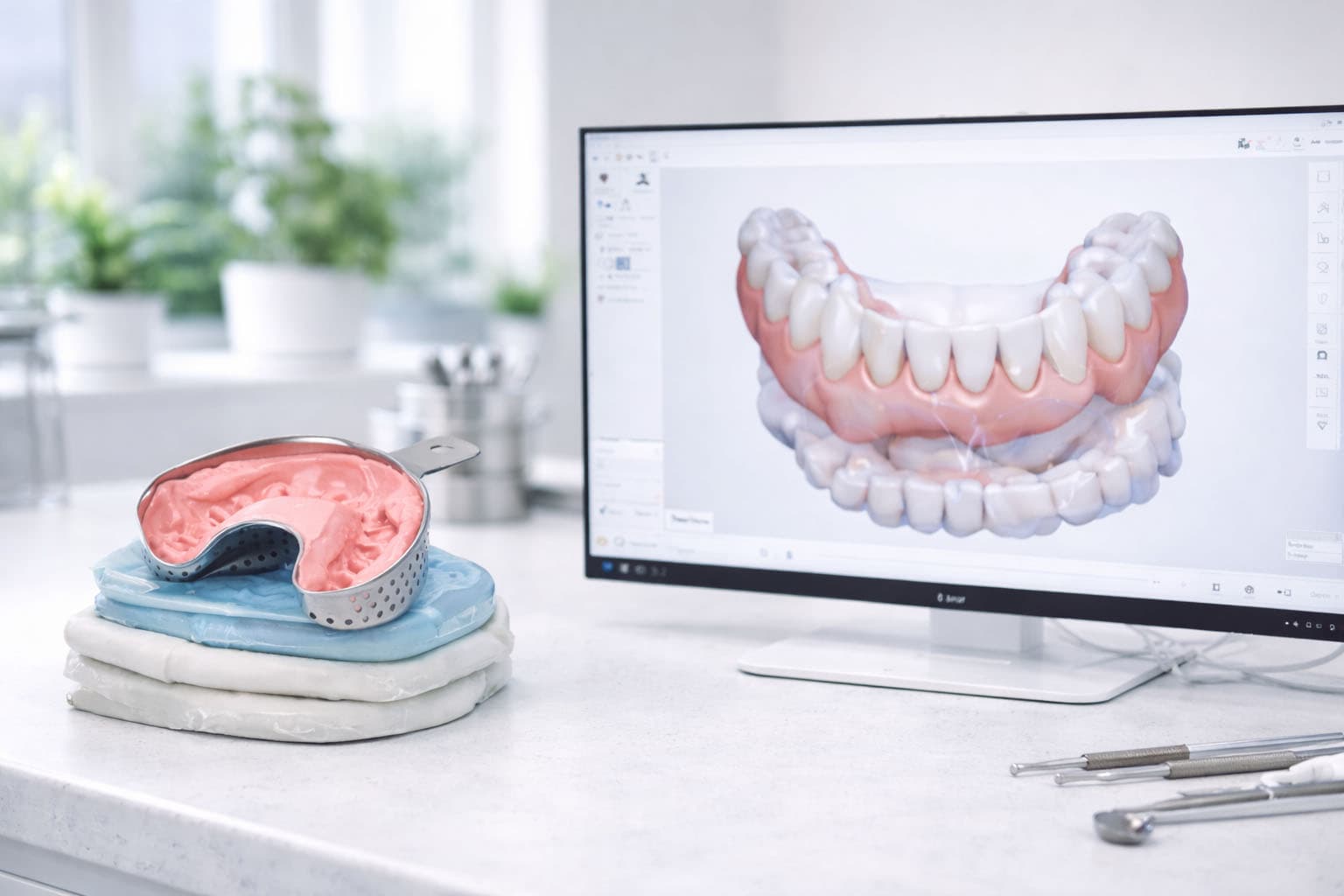
Your pre-appointment prep is about having the right trays, adhesive, VPS or alginate, mixing tips, retraction aids, disinfection, and the habit of “we’ll see if it works.”
You can be fully stocked and still walk into variability. The material does what the material does.
Digital: preparation is mostly procedural
You’re prepping a system. The scanner needs to be ready, calibrated if required (some are calibration-free), tips sterilized, software open, patient record created, scan strategy clear.
The practical changes that show up in clinics:
- A scanner-ready station becomes a real thing, not “grab a tray”
- Tip logistics become a daily flow (sterilization cycles, spare tips, tracking wear)
- Software state matters (updates, licenses, workflows, correct patient file)
- Someone must own device readiness the way someone owns instrument setup
If you do not assign ownership here, scanning fails before it begins. The appointment starts with “where is the scanner” or “why is it not connected,” and you’ve already burned the time you thought scanning would save.
2) During the appointment
This is where people misread the shift.
Traditional impressions have a long “dead time” where the material sets. Digital scanning has fewer dead moments but more continuous micro-decisions.
Traditional: one high-stakes attempt
Once the tray is loaded and seated, you’re committed. If the capture is poor, you often find out only after removal. Some errors are obvious in-chair, but many are subtle and reveal themselves as distortion, tears at margins, or missing detail.
The workflow is chunky:
- Select tray and check fit
- Retract and dry as best as possible
- Load tray, seat tray
- Wait
- Pull, inspect, disinfect, package, ship
If it fails, you restart the whole thing. That makes retakes psychologically expensive and time-expensive.
Closing thought
Digital impressions do not automatically save time. They change where time is spent.
With trays, you pay later. With scanning, you pay now.
If you standardize scan path, bite capture, QC, and file handoff, you convert “later” time into “now” fixes, and your remake loop collapses. That’s when scanning stops feeling like extra steps and starts feeling like control.
Related Dental Articles



We'll give you a reason to smile more. Sign up today.


